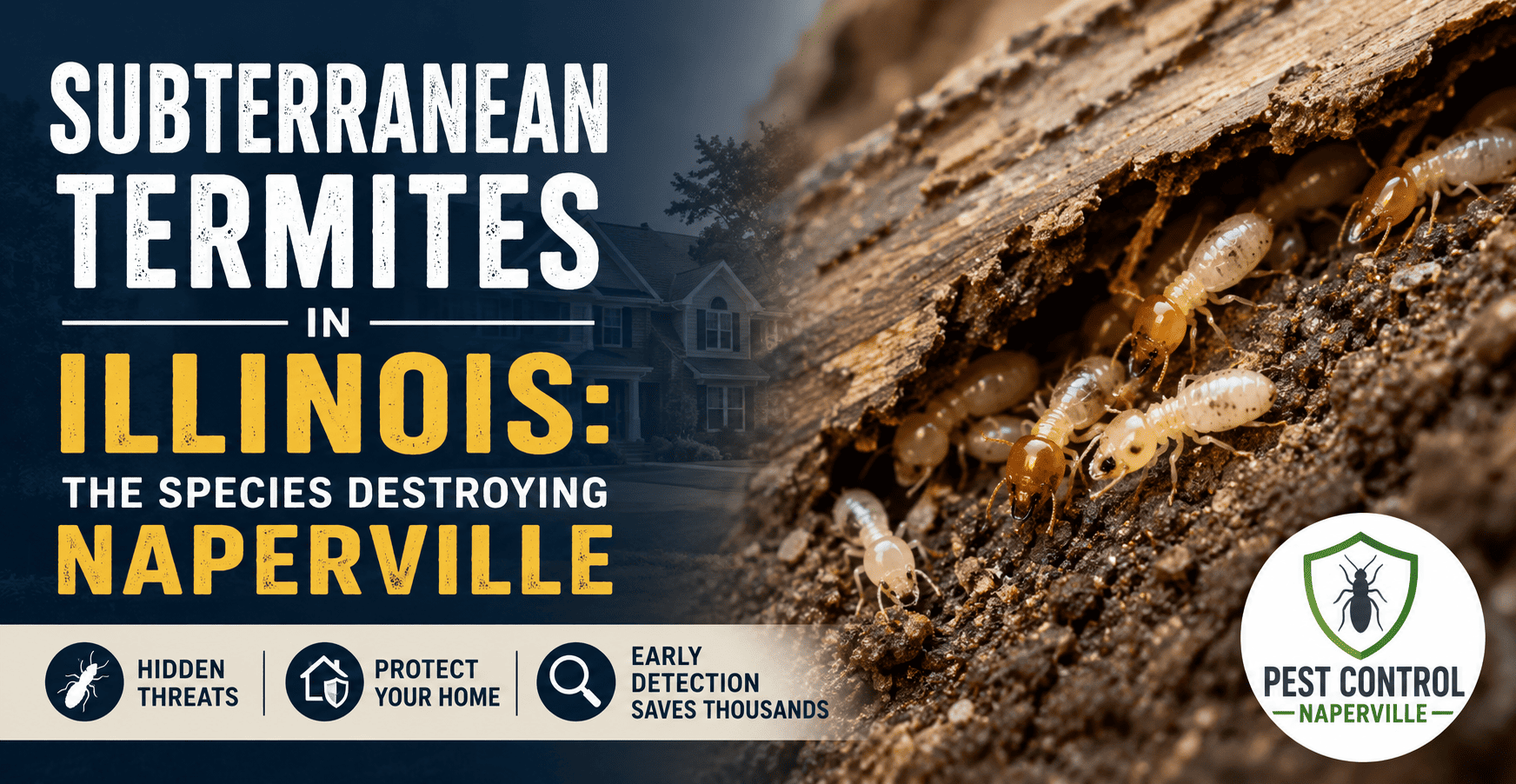
Naperville homes are attacked almost exclusively by the eastern subterranean termite (Reticulitermes flavipes), the most common and most destructive termite in Illinois. These insects nest in the soil, tunnel up through foundations, and quietly eat structural wood from the inside out, often for years before a homeowner notices.
Meet the species eating Naperville homes
Illinois has one termite that matters for homeowners, and it lives underground. The eastern subterranean termite is a social insect that builds large colonies in the soil around your foundation, then travels to your house in search of cellulose, the material in wood, cardboard, and paper.
Unlike drywood termites (a Southern and coastal problem), subterranean termites must stay connected to moist soil. That single fact shapes everything about how they behave, how they get inside, and how professionals stop them. It also explains why our clay-heavy soils and wet springs across DuPage County and Will County create such favorable conditions for them.
A colony runs on three castes:
- Workers: creamy-white, wingless, and the ones actually chewing through your joists and subfloor.
- Soldiers: larger heads and dark jaws, tasked with defending the colony.
- Swarmers (alates): the winged reproductives you may see in spring. Their job is to fly out and start new colonies.
If you spot winged insects indoors, it helps to know how to tell a termite from a flying ant before you panic; the two are easy to confuse and call for very different responses.
Why Naperville is prime termite territory
Several local conditions stack the deck in the termite’s favor:
- Moisture-retaining soil. Northern Illinois clay holds water against foundations, keeping the soil humid and colony-friendly.
- Older and mixed-age housing stock. Homes with wood siding close to grade, wood mulch beds, and untreated crawl spaces give termites easy entry.
- Freeze-thaw cracking. Our winters open hairline cracks in slabs and foundation walls, perfect hidden highways.
- Landscaping habits. Mulch piled against the foundation, buried scrap wood, and wood-to-soil contact all invite trouble.
Warning signs you have subterranean termites
Subterranean termites are secretive, but they leave evidence. Watch for:
- Mud tubes: pencil-width tunnels of soil and saliva running up foundation walls, piers, or crawl space surfaces. This is the single most reliable sign.
- Spring swarmers: clusters of winged insects near windows or light fixtures, usually on warm days after rain.
- Discarded wings: small, equal-length wings piled on windowsills after a swarm.
- Hollow or blistered wood: trim or flooring that sounds papery when tapped.
- Sagging or bubbling paint: that looks like water damage.
- Stuck windows and doors: from warped, weakened frames.
Because damage hides inside walls, most homeowners find these clues late. Our detailed breakdown of the early warning signs of termites walks through each one with photos.
The damage they cause and why it’s expensive
Subterranean termites collectively cause billions of dollars in property damage across the U.S. every year, according to the National Pest Management Association (NPMA). What makes them costly is stealth: they eat wood along the grain, leaving a thin outer shell intact, so a beam can be structurally compromised while looking fine.
Common targets in Naperville homes include sill plates, floor joists, subflooring, wall studs near the foundation, and any wood touching soil. Left untreated, an infestation can move into load-bearing framing, and standard homeowners insurance rarely covers termite damage, because it’s considered preventable.
When termites are most active in Illinois
| Season | Termite activity | What homeowners notice |
|---|---|---|
| Spring (Mar–May) | Peak swarming | Winged reproductives indoors and out; new colonies form |
| Summer | High feeding | Fastest wood consumption; mud tube expansion |
| Fall | Steady but hidden | Colonies stockpile before cold; fewer surface signs |
| Winter | Slowed near surface | Activity continues in heated crawl spaces and slabs |
The takeaway: termites never truly “leave.” Heated homes let them feed year-round below the frost line. For the bigger picture on timing, see how seasonal changes in Naperville affect pest activity.
Prevention: making your home a hard target
You can’t eliminate termites from the soil, but you can make your house unattractive and hard to reach. A practical prevention checklist:
- Keep mulch, soil, and wood chips at least 6 inches below siding and wood trim.
- Fix leaks, dripping faucets, AC condensate lines, and poor grading feed colonies.
- Redirect water with clean gutters and downspout extensions that carry runoff away from the foundation.
- Ventilate crawl spaces and reduce humidity; consider a vapor barrier.
- Remove wood-to-soil contact: deck posts, fence bases, and buried lumber.
- Store firewood off the ground and away from the house.
- Seal foundation cracks and utility penetrations.
Our full termite prevention guide for Naperville homeowners expands on each step.
DIY vs. professional treatment
| Factor | DIY approach | Professional treatment |
|---|---|---|
| Detection | Surface signs only | Full inspection, including crawl spaces and hidden areas |
| Products | Retail sprays, limited reach | Professional-grade non-repellent termiticides and bait systems |
| Colony elimination | Rarely achieved | Targets the colony, not just visible termites |
| Warranty | None | Renewable protection plans and re-inspection |
| Best for | Minor prevention tasks | Any confirmed or suspected infestation |
Retail products can kill the termites you see, but they don’t reach the colony in the soil, which simply reroutes. This is a classic case where the math favors professional help, a point we make in our DIY vs. professional pest control comparison.
How professionals treat subterranean termites
Modern termite control follows Integrated Pest Management (IPM) principles: inspection first, then the least invasive effective treatment. Two proven methods dominate:
- Liquid soil barriers. A non-repellent termiticide is applied around the foundation. Termites can’t detect it, pass through it, and carry the active ingredient back to the colony.
- In-ground bait stations. Stations placed around the property intercept foraging workers with a slow-acting bait that collapses the colony over time. Bait systems are low-disruption and excellent for ongoing monitoring.
Many homes do best with a combined approach, plus an annual termite inspection. Because treatment cost depends on home size, construction, and infestation level, a professional inspection gives you a real number rather than a guess.
Common termite myths
- “Brick homes are safe.” False. Termites travel through tiny gaps in brick, block, and slab to reach the wood framing inside.
- “I’d see them.” Rarely, workers avoid light and stay hidden in wood and soil.
- “One treatment lasts forever.” Barriers and baits need monitoring and periodic renewal.
- “Termites and carpenter ants are the same.” Different pests, different treatment. If you’re seeing sawdust-like shavings, that points toward carpenter ants in the walls, not termites.
When to call a professional
Call for an inspection if you notice mud tubes, a spring swarm, discarded wings, or hollow-sounding wood — or simply if your home has never been inspected. Termite damage compounds silently, so early detection is the cheapest outcome. Homeowners across Naperville and nearby communities like Plainfield, Bolingbrook, Wheaton, and Lisle share the same soil and climate risks, so an annual check is smart insurance.
Frequently asked questions
What kind of termites live in Illinois?
Illinois homes are almost always affected by the eastern subterranean termite. Drywood and Formosan termites, common in the South, are not established in northern Illinois’s climate.
How do I know if I have subterranean termites?
Look for mud tubes on foundation walls, spring swarms of winged insects, discarded wings on windowsills, and hollow-sounding wood. A professional inspection confirms active infestation.
When do termites swarm in Naperville?
Subterranean termites typically swarm in spring, from roughly March to May, on warm days after rain. Seeing swarmers indoors strongly suggests an active colony nearby.
Can I get rid of termites myself?
DIY sprays kill visible termites but rarely reach the underground colony, so infestations return. Professional soil treatments and bait systems target the colony directly.
Does home insurance cover termite damage?
Usually not. Termite damage is considered preventable through maintenance, so most policies exclude it, making prevention and early treatment the affordable choice.
How often should I get a termite inspection?
Once a year is standard for Illinois homes, plus any time you spot warning signs. Annual inspections catch problems before they reach structural framing.
Protect your Naperville home before the next swarm
If you’ve seen mud tubes, swarmers, or wood that just doesn’t sound right, don’t wait for spring to confirm it. Our licensed local team knows exactly how eastern subterranean termites behave in DuPage and Will County soil. Contact Pest Control Naperville to schedule a termite inspection and get a clear, honest assessment of your home.