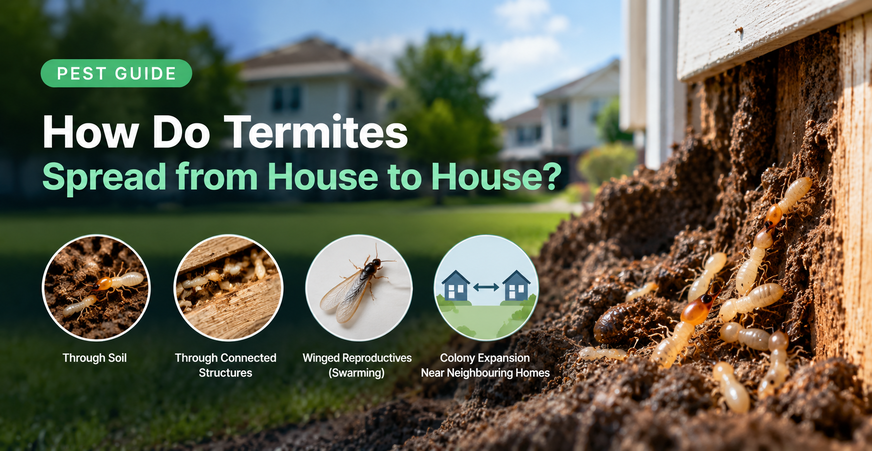
Termites can affect more than one property, but they rarely move from one house to the next in a simple, predictable way. Subterranean termites live in soil colonies that forage underground, and one colony’s foraging area may reach more than one yard. Separately, winged reproductives leave mature colonies in spring to try to start new ones. A neighbor’s termite problem is a reason to pay attention, not proof that your home is infested.
Key Takeaways
- “Spreading” can mean three different things: a colony foraging through soil, termites using connected structures or materials, and winged termites starting new colonies.
- Extension entomologists describe a colony’s foraging range as difficult to predict, so there is no reliable travel distance.
- Winged termites are weak fliers, and only a small share survive to found colonies.
- Moisture problems and wood in contact with soil raise risk.
- A treatment is designed for the building it protects. It does not extend to neighboring properties.
Can Termites Really Spread From One House to Another?
Sometimes, but how it happens matters. The termites most associated with Illinois are subterranean, mainly the eastern subterranean termite (Reticulitermes flavipes), documented in a University of Illinois Natural History Survey circular. Their biology differs from drywood termites, so the paths below apply to subterranean species.
Foraging through the soil
Subterranean termites live in soil and send workers out through tunnels to find wood and other cellulose. Virginia Tech Extension notes that large colonies often become decentralized, occupying several nesting sites linked by underground tunnels. The same source says foraging range is hard to predict: small colonies may cover only a few yards, some larger ones may cover an area the size of a football field, and a colony may not forage its whole range at any given time.
Soil has no property lines, so one colony could in principle reach structures on adjacent lots. Whether it does depends on the species, colony size, soil, moisture, and what food is available.
Moving through connected structures and materials
When foraging termites reach a building, they travel between soil and wood inside protective mud tubes. Virginia Tech describes working tubes that run over foundations and along walls to reach structural wood. Where homes share foundations, slabs, or wall framing, connected construction could offer routes between units. The sources reviewed give no simple rule for this, so risk depends on how the buildings were built.
Swarming and new colonies
Mature colonies produce winged reproductives, called swarmers. They emerge in spring, usually on warm days after rain, and are attracted to light. After a short flight, pairs land, shed their wings, and try to start a colony in soil. Texas A&M Extension says swarmers are weak fliers that travel short distances, and only a small percentage survive to establish colonies. Swarmers that emerge indoors usually die within hours unless there is enough moisture, according to Pest Control Technology. Timing in Illinois may differ slightly from the Virginia and Texas figures cited here.
A Neighboring Colony vs. a New Colony in Your House
These situations are easy to confuse:
- Extended foraging. The same colony finds a second food source, such as your house. No new colony has started.
- Colony splitting. A group of workers and reproductives becomes isolated and starts a sub-colony. Texas A&M notes this can happen without swarming, and the sub-colony may stay independent or rejoin the parent.
- A swarmer-founded colony. A new king and queen start from scratch in soil near suitable wood.
The difference affects what a professional looks for and how monitoring is planned.
What Raises the Risk?
- Moisture. Virginia Tech says above-ground infestations are almost exclusively found where moisture problems persist, such as leaking pipes or poorly ventilated crawl spaces.
- Wood touching soil. Texas A&M says new colonies start near wood in contact with soil.
- Debris and landscaping. Stored lumber, stumps, and mulch piled against a foundation can supply food and moisture near the house.
- Nearby activity. Termites found next door suggest conditions in the area may suit them.
- Past activity. A home with prior termite history deserves periodic checks.
Attached Homes, Townhouses and Shared Structures
Risk is not the same for every property type. In townhouses, condos, and duplexes, shared foundations, slabs, and wall framing may offer termites more routes. Detached homes with close-set lots, which are common in many Naperville neighborhoods, share soil even when they share no walls. Either way, termite activity in one unit is a reason for neighbors to be checked.
Warning Signs of Termite Activity
- Mud tubes on foundation walls, piers, or plumbing. Rutgers Extension says active tubes tend to be darker and moist, and may contain live termites. Old tubes can remain from past infestations.
- Swarmers or discarded wings near windows, doors or light sources, especially in spring.
- Damaged or hollow-sounding wood. EPA suggests probing exposed wood for hollow spots.
Some damage stays hidden. Rutgers notes mud tubes are often absent, and it is hard for a layperson to tell old damage from new.
How to Reduce Your Risk
- Repair leaks, clear gutters, and improve crawl-space ventilation.
- Keep structural wood, siding, and wood trim off the soil.
- Store firewood and lumber away from the foundation, and remove old stumps and buried wood debris.
- Avoid piling mulch against the foundation.
- Inspect the foundation, basement, and crawl space each year, and schedule professional inspections when appropriate.
These steps lower conditions that favor termites, but they do not guarantee protection. EPA regulates termite pesticides, and product labels must be followed. Most termite treatments are applied by licensed professionals.
When to Get a Professional Inspection
Consider an inspection if termites are found nearby, you see mud tubes, swarmers or damaged wood indoors, or your property has a history of termite activity. Mississippi State Extension says more than a few native swarmers indoors, or any mud tubes, warrant a professional inspection. A professional can confirm the species and extent of activity, which a description alone cannot.
Frequently Asked Questions
Can termites move through walls?
In an infested building, workers can tunnel within wood and use voids. Mud tubes may appear on interior walls. Mississippi State notes termites do not eat sprayed foam insulation but can tunnel through it.
Does neighboring termite activity mean my home is infested?
No. It means conditions nearby suit termites. Your home may be unaffected, or termites may be present unseen. Only an inspection can tell.
How do termites enter houses?
Usually from the soil, through wood touching the ground or mud tubes built over foundations. Cracks and gaps can also give access. Chronic moisture can allow colonies to survive above ground.
Does a termite treatment protect neighboring properties?
No. A treatment is designed around one structure. Pest Control Technology also notes that workers cut off from a colony can form a satellite colony where moisture is sufficient, so treatment results vary.
Are flying termites the same as flying ants?
No. Termites have straight antennae, a thick waist, and wings of equal size. Ants have elbowed antennae, a narrow waist, and unequal wings, per Texas A&M. Termite swarmers seen outdoors may simply be passing by, as a Purdue entomologist noted. Indoors, they deserve a closer look.
Next Step
If you have found termite signs or a neighbor has, a professional inspection can clarify your situation. Pest Control Naperville offers termite inspection and prevention, including bait stations and barriers, according to its website. You can also use the contact page to ask questions.